
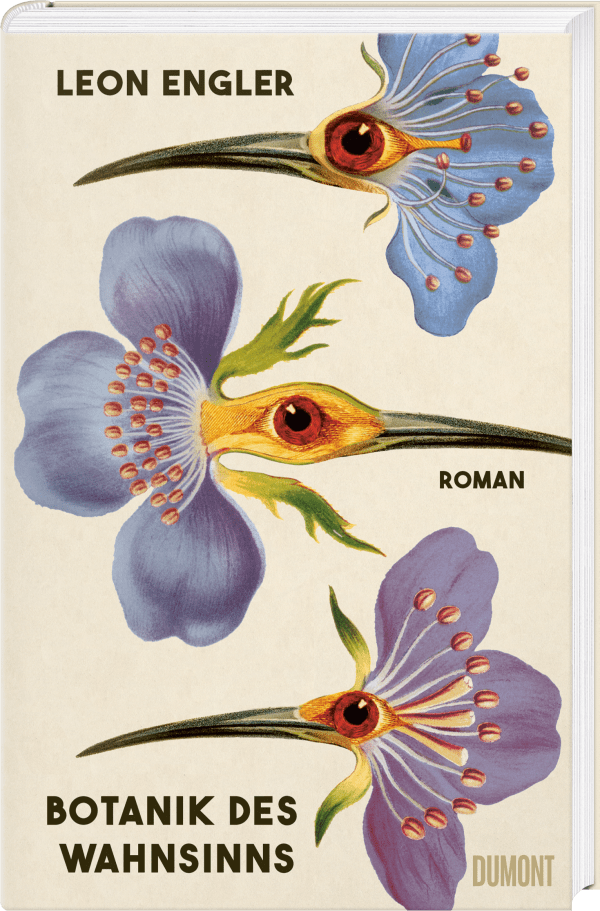





Botanik des Wahnsinns
Roman | »Unwiderstehlich. Leichtfüßig und ernst, zärtlich und brutal, ironisch und ehrlich.« Siri Hustvedt
208 pages
Dieser Titel ist in Ihrer lokalen Buchhandlung oder hier erhältlich:
»Ein fantastisches Buch – abgrundtief und doch tröstend. Hab’s verschlungen.« DORIS DÖRRIE
LEON ENGLER
Botanik des Wahnsinns /Botany of Madness
A Novel, 208 pages August 2025
English sample available
“Irresistible. A book that is at once grave and light, tender and tough, satirical and earnest.” Siri Hustvedt
“A fantastic book—profound yet comforting. I devoured it.” Doris Dörrie
Selected for New Books In German
Shortlisted for ZDF „aspekte“ Literature Prize 2025
Shortlisted for Evangelischer Buchpreis 2026 Selected for New Books In German
“What happens to memory once one begins to speak about it, or even write it down – can this really be explored, problematised, and even enriched again and again through literature? Is that even possible after Marcel Proust, Virginia Woolf, William Faulkner […], after […]Siri Hustvedt, Annie Ernaux, Karl Ove Knausgård and so many others who have made it the very subject of their work and their lives? The bar here is truly set high, and for that reason the very attempt is already commendable – all the more so for a debut author. We watch Leon Engler […] doing exactly this and exclaim: Wow!” Jan Wiele, FRANKFURTER ALLGEMEINE ZEITUNG
“A major discovery in this literary autumn! … With poetic laconicism and astonishingly dry precision, Engler recounts a family story as unbelievable as it is harrowing. […] With his ‘Botany of Madness’, Leon Engler invites us to explore inner landscapes.” Jürgen Kanold, SÜDWEST-PRESSE
“Engler's novel, set between a mental asylum and a coffee house, impressively describes how our need for clear categories struggles with the complexity of the human soul. He strikes a tone that oscillates between dreamy and detached, seeming to float above the hardships of life without becoming indifferent. Engler has thus achieved a psychological feat.” Lena Karger – WELT AM SONNNTAG
A tragicomic family novel that tells of the supposedly crazy and the allegedly normal.
Leon Engler's debut is a tender stroke of liberation, a story of reconciliation.
About Someone Who Set Out Not to Go Mad
A young man suffers from a panicky fear of going insane. No wonder, as a stay in a psychiatric hospital is almost normal in his family. In biology class, he learns about heredity. The offspring of titmice are titmice. The offspring of pumpkins are pumpkins. So what are the offspring of his depressive father, his alcoholic mother, his schizophrenic grandfather, and his bipolar grandmother? He makes an initial calculation. Depression: forty percent hereditary. Alcohol dependence: fifty percent hereditary. Bipolar disorder: eighty percent hereditary. The prognosis? One hundred percent bad. He tries to escape: to New York, to Paris, to Vienna. He tries to attack: he becomes a psychologist and works in psychiatry. Right there, where he never wanted to be, he sees his family's history in a new light.
Rights sold to: OceanMore (Croatian); Gyldendal (Danish); De Arbeiderspers (Dutch); New Vessel Press (English – North American Rights); Scribe (English UK Commonwealth excl. Canada); Libri (Hungarian); Feltrinelli Gramma (Italian); Filtry (Polish); Koridor (Turkish);
Botanik des Wahnsinns /Botany of Madness
A Novel, 208 pages August 2025
English sample available
“Irresistible. A book that is at once grave and light, tender and tough, satirical and earnest.” Siri Hustvedt
“A fantastic book—profound yet comforting. I devoured it.” Doris Dörrie
Selected for New Books In German
Shortlisted for ZDF „aspekte“ Literature Prize 2025
Shortlisted for Evangelischer Buchpreis 2026 Selected for New Books In German
“What happens to memory once one begins to speak about it, or even write it down – can this really be explored, problematised, and even enriched again and again through literature? Is that even possible after Marcel Proust, Virginia Woolf, William Faulkner […], after […]Siri Hustvedt, Annie Ernaux, Karl Ove Knausgård and so many others who have made it the very subject of their work and their lives? The bar here is truly set high, and for that reason the very attempt is already commendable – all the more so for a debut author. We watch Leon Engler […] doing exactly this and exclaim: Wow!” Jan Wiele, FRANKFURTER ALLGEMEINE ZEITUNG
“A major discovery in this literary autumn! … With poetic laconicism and astonishingly dry precision, Engler recounts a family story as unbelievable as it is harrowing. […] With his ‘Botany of Madness’, Leon Engler invites us to explore inner landscapes.” Jürgen Kanold, SÜDWEST-PRESSE
“Engler's novel, set between a mental asylum and a coffee house, impressively describes how our need for clear categories struggles with the complexity of the human soul. He strikes a tone that oscillates between dreamy and detached, seeming to float above the hardships of life without becoming indifferent. Engler has thus achieved a psychological feat.” Lena Karger – WELT AM SONNNTAG
A tragicomic family novel that tells of the supposedly crazy and the allegedly normal.
Leon Engler's debut is a tender stroke of liberation, a story of reconciliation.
About Someone Who Set Out Not to Go Mad
A young man suffers from a panicky fear of going insane. No wonder, as a stay in a psychiatric hospital is almost normal in his family. In biology class, he learns about heredity. The offspring of titmice are titmice. The offspring of pumpkins are pumpkins. So what are the offspring of his depressive father, his alcoholic mother, his schizophrenic grandfather, and his bipolar grandmother? He makes an initial calculation. Depression: forty percent hereditary. Alcohol dependence: fifty percent hereditary. Bipolar disorder: eighty percent hereditary. The prognosis? One hundred percent bad. He tries to escape: to New York, to Paris, to Vienna. He tries to attack: he becomes a psychologist and works in psychiatry. Right there, where he never wanted to be, he sees his family's history in a new light.
Rights sold to: OceanMore (Croatian); Gyldendal (Danish); De Arbeiderspers (Dutch); New Vessel Press (English – North American Rights); Scribe (English UK Commonwealth excl. Canada); Libri (Hungarian); Feltrinelli Gramma (Italian); Filtry (Polish); Koridor (Turkish);
Rights inquiries
Leon Engler
Leon Engler grew up in Munich and studied theatre, film, media, cultural studies and psychology in Vienna, Paris and Berlin. He has published...
Leon Engler grew up in Munich and studied theatre, film, media, cultural studies and psychology in Vienna, Paris and Berlin. He has published numerous theatre plays, radio plays and short stories and was awarded the 3sat Prize at the Bachmann Competition in 2022. He works as an author, psychologist and lecturer in psychology and literary writing. 'Botany of Madness' is his debut novel.